
In the high-stakes world of DeFi, where Ethereum hovers at $3,017.09 amid a 24-hour dip of just 0.76%, projects face a stark reality: allowlists demand rigorous KYC verification to unlock institutional capital, yet users recoil from exposing personal data on public ledgers. Privacy-preserving onchain KYC attestations cut through this tension, delivering KYCed addresses verification that safeguards identities while enabling seamless access to gated pools, token sales, and communities.
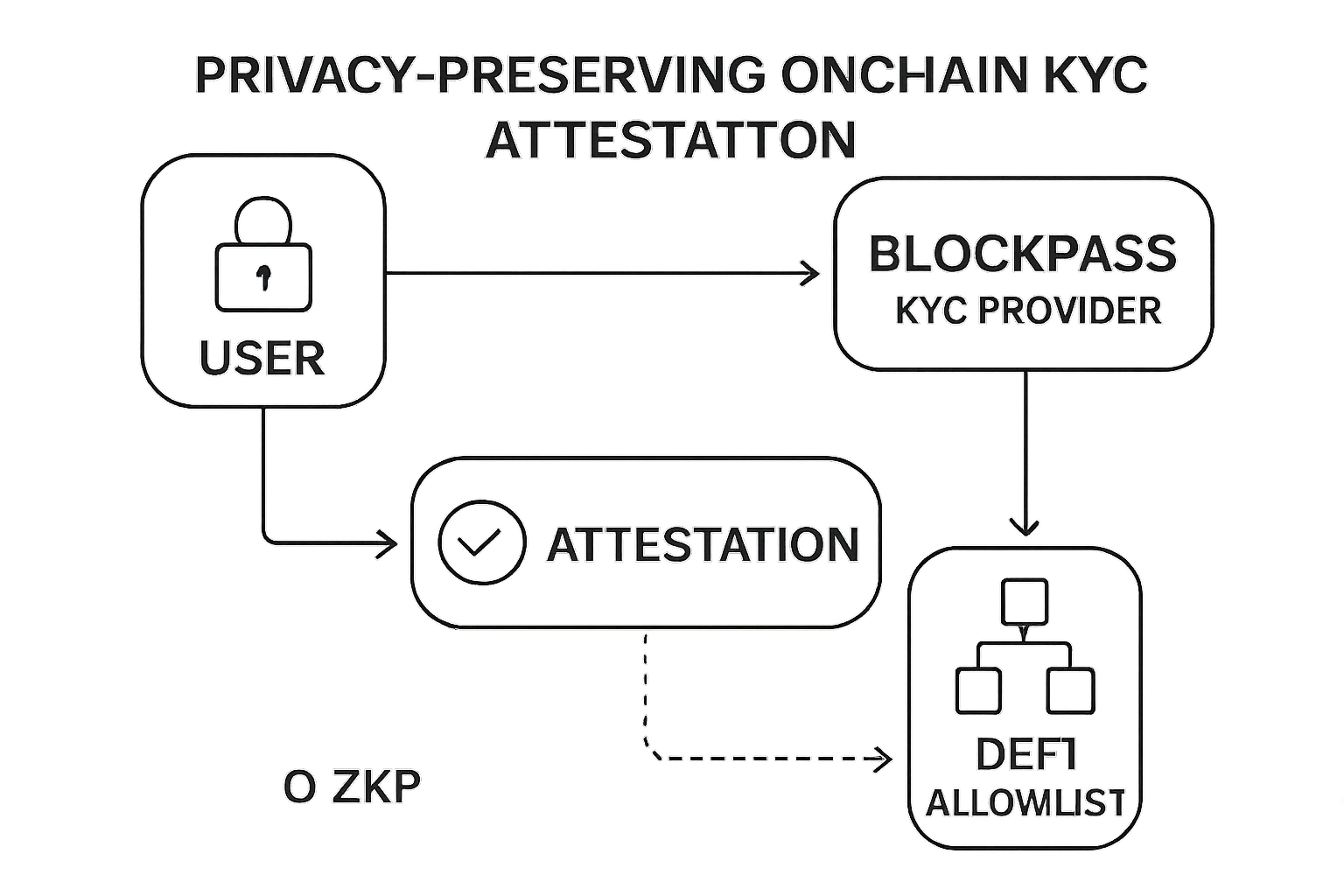
This innovation arrives at a pivotal moment. Blockpass's On-Chain KYC® 2.0 sets the pace by issuing blockchain attestations that verify identity without storing sensitive data, a direct response to platforms like Chainlink's Automated Compliance Engine (ACE) tackling onchain compliance head-on. As DeFi matures, privacy-preserving KYC Web3 solutions like these aren't optional; they're the data-backed pathway to scaling trust without centralization creep.
Decoding Onchain KYC Attestations for DeFi Allowlists
At their core, onchain KYC attestations are cryptographic vouchers etched into blockchains like Ethereum, proving an address meets KYC standards minus the personal details. Unlike offchain checks that fragment verification, these leverage Ethereum Attestation Service (EAS) standards for immutability and interoperability. Picture a Soulbound Token (SBT) from Hypersign: it mints post-verification, letting users flash-proof compliance across dApps without doxxing.
Allowlists thrive here. Cube Exchange highlights how these mechanisms gate wallets, smart contracts, and NFTs, mitigating risks like wash trading or regulatory flags. Derechofurther innovates with proof-carrying disclosures in privacy pools, propagating allowlist proofs through transaction graphs. The result? DeFi allowlist KYC that scales, as experimental arXiv evaluations show ZKP variants slashing verification latency by orders of magnitude.
"Experimental evaluation of our KYC-compliant DeFi implementation shows considerable performance improvement for different proof types. " - Privacy-Preserving On-chain Permissioning for KYC (arXiv)
Technological Pillars Powering Privacy-Preserving Verification
Zero-knowledge proofs (ZKPs) form the bedrock, allowing proofs of KYC compliance sans attribute revelation. ZKlaims exemplifies this with non-interactive ZK for attribute-based credentials. Layered atop verifiable credentials (VCs), users hold signed assertions, like age or residency, from issuers like Togggle, convertible to onchain signals.
Self-sovereign identity (SSI) elevates control, merging with ZKPs for permissioned dApps. Altme's wallet exemplifies this, blending decentralized identifiers with ZK to share compliance proofs onchain. Sign Protocol extends reach as an omni-chain attestation layer, signing any datum for verification. These stacks ensure EAS attestations for KYC aren't siloed but reusable, slashing repeated KYC friction that plagues Web3.
Ethereum (ETH) Price Prediction 2026-2031
Short-term outlook amid DeFi compliance innovations with privacy-preserving onchain KYC attestations
| Year | Minimum Price | Average Price | Maximum Price |
|---|---|---|---|
| 2026 | $2,800 | $4,500 | $6,500 |
| 2027 | $3,500 | $6,000 | $9,000 |
| 2028 | $4,200 | $8,000 | $13,000 |
| 2029 | $5,000 | $10,000 | $16,000 |
| 2030 | $6,000 | $13,000 | $22,000 |
| 2031 | $7,500 | $17,000 | $30,000 |
Price Prediction Summary
Ethereum (ETH) is forecasted to experience robust growth from 2026-2031, driven by privacy-preserving onchain KYC attestations that bridge regulatory compliance and DeFi privacy. Starting from ~$3,000 in 2025, average prices could rise over 5x by 2031 in bullish scenarios, with min/max ranges accounting for market cycles, bear markets (10-20% drawdowns), and bull runs (50-100% gains). Overall CAGR ~40% on averages, supported by institutional adoption and tech upgrades.
Key Factors Affecting Ethereum Price
- Adoption of privacy-preserving KYC solutions like Blockpass On-Chain KYC 2.0 and Chainlink ACE boosting DeFi TVL
- Ethereum scalability improvements via L2s and ZK tech enhancing onchain compliance use cases
- Regulatory clarity enabling institutional inflows while preserving decentralization
- Market cycles influenced by BTC halvings and macro trends
- Competition from Solana/Alts balanced by ETH's DeFi dominance and network effects
- Advancements in ZKPs, verifiable credentials, and SSI driving interoperability across platforms
Disclaimer: Cryptocurrency price predictions are speculative and based on current market analysis. Actual prices may vary significantly due to market volatility, regulatory changes, and other factors. Always do your own research before making investment decisions.
Blockpass leads implementations, supporting Ethereum and Solana with customizable attestations for docs and residency. Their 2.0 upgrade empowers reusable identities, shielding businesses from data custody risks, a Globe and Mail nod underscores the privacy pivot.
Real-World Deployments and Performance Edges
Chainlink ACE unifies compliance modules, onboarding institutional flows via modular standards. Ethereum Research laments lost privacy in public chains, yet solutions like these restore confidentiality for impactful apps. Onchain vs. offchain? EAS attestations win on security and auditability, directly tackling allowlist/blocklist dynamics in exchanges and NFTs.
Hypersign's SBT model proves sticky: one verification, endless proofs. Altme integrates SSI wallets for dApp gating, while emerging protocols like Derecho weave ZK into privacy pools. Data from arXiv benchmarks reveal ZKP efficiencies enabling sub-second verifications, critical as ETH stabilizes at $3,017.09 and DeFi TVL eyes trillions.
Performance metrics underscore the edge. arXiv studies clock ZKP-based permissioning at latencies under 200ms for complex proofs, a 10x leap over legacy oracles, even as Ethereum's gas fees stabilize post-Dencun. This efficiency lets DeFi allowlist KYC gate high-value pools without bottlenecking user flows, directly fueling TVL growth.
Quantifying Impact: Metrics and Benchmarks
Let's drill into the numbers. Blockpass reports 99.9% uptime across Ethereum and Solana, with attestations verifiable in under 5 seconds via standard RPC calls. Hypersign's SBTs have seen 50,000 and mints since launch, per their docs, proving demand for EAS attestations for KYC. Altme's SSI integrations cut onboarding time by 70%, from hours of manual KYC to instant proofs.
Chainlink ACE amplifies this, modularizing compliance for institutional onramps. Its oracle network verifies attestations tamper-proof, bridging TradFi scrutiny to DeFi speed. Sign Protocol's omni-chain layer signs arbitrary data, from KYC to reputational scores, fostering composable allowlists that evolve with user activity.
Yet real deployments reveal nuances. Cube Exchange notes allowlist risks like sybil attacks, where onchain attestations shine by anchoring to cryptographic roots. Derecho's proof-carrying data propagates membership through privacy pools, letting users enter without fresh disclosures, a game-changer for repeat interactions in DEXs or lending protocols.
Navigating Hurdles to Mainstream Adoption
Scalability bites first. Ethereum at $3,017.09 handles peak loads, but L2s like Optimism amplify throughput for attestation schemas. Standardization lags; EAS dominates Ethereum, but cross-chain needs bridges like LayerZero. Regulatory fog persists, with FATF travel rules eyeing onchain signals, though privacy layers like ZKPs blunt overreach.
Security demands vigilance. Auditor reports from Quantstamp on Blockpass attestations show zero exploits, but oracle dependencies in ACE warrant diversified feeds. User education gaps persist; not every DeFi denizen grasps SSI wallets, risking misconfigurations. Still, data tilts positive: Ethereum Research forums buzz with prototypes restoring "decentralized private internet" dreams via confidential txs.

OnchainKYCe. me steps into this arena with laser focus. Tailored for Web3 projects, it issues secure attestations for KYCed addresses verification, integrating seamlessly with allowlists for token sales and gated DAOs. No data silos, just verifiable proofs that travel chains, empowering managers to scale without custody nightmares. Check out how onchain attestations simplify KYC for DeFi airdrops and allowlists or how they enable secure KYC verification for Web3 allowlists.
Venture forward, and the trajectory clarifies. As ETH holds $3,017.09 through volatility, projects wielding privacy-preserving KYC Web3 tools like On-Chain KYC® 2.0 or OnchainKYCe. me unlock billions in sidelined capital. Allowlists evolve from static gates to dynamic, proof-fueled engines, where verified addresses drive frictionless innovation. DeFi's next phase isn't compliant by compromise; it's sovereign by design.




No comments yet. Be the first to share your thoughts!