
What onchain KYC 2026 actually means
Onchain KYC replaces the traditional model of static database checks with dynamic, user-controlled verifiable credentials stored directly on the blockchain. Instead of submitting personal documents to a centralized intermediary for every new application, users undergo a one-time verification process. The resulting identity proof is issued as a digital credential that can be reused across multiple platforms without re-entering sensitive data.
This shift relies on smart contracts and oracles to bridge off-chain identity data with on-chain applications. As noted by Chainlink, onchain KYC verifies user identity for blockchain applications through these integrated systems, ensuring that compliance data is accessible to authorized parties while maintaining the integrity of the blockchain environment. Blockpass further describes this as "On-Chain KYC® 2.0," which empowers issuers to create verifiable and reusable digital identities for their users, both on and off the blockchain.
The operational difference is significant. In a traditional workflow, a user’s identity is siloed within a single institution’s database. In an onchain model, the user holds the credential in a digital wallet and presents only the necessary proof of compliance—such as "verified human" or "jurisdiction-approved"—to a smart contract. This approach reduces redundancy, enhances privacy through selective disclosure, and aligns DeFi protocols with emerging regulatory standards that require transparent, auditable identity trails without exposing raw personal information.
How Decentralized Identity Verification Works
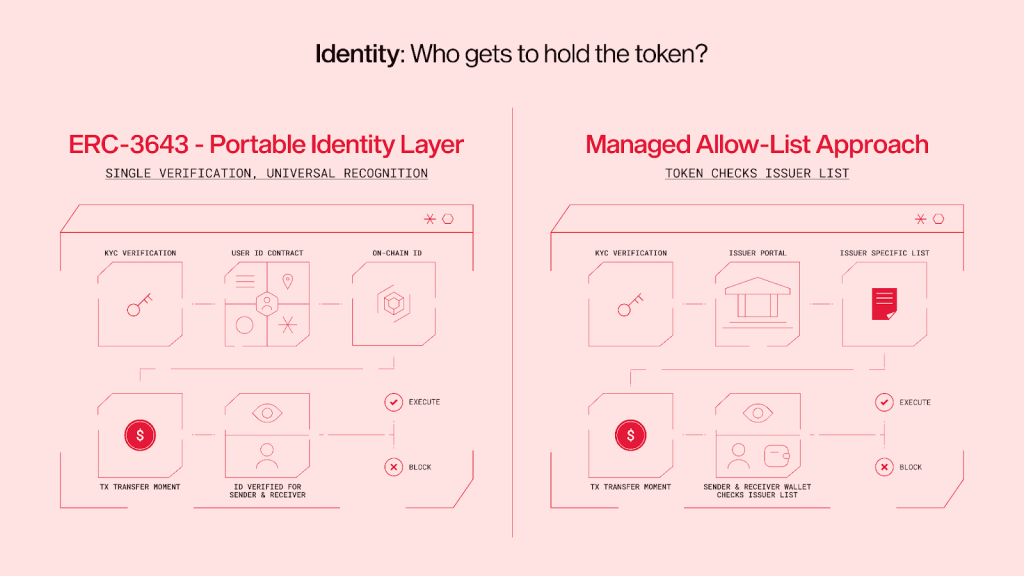
Onchain KYC relies on a modular architecture that separates identity verification from the applications that consume it. Rather than requiring users to submit personal documents to every DeFi protocol, the system uses smart contracts and decentralized oracles to issue reusable digital attestations. This approach allows a user to verify their identity once with a trusted provider and then present proof of compliance to multiple protocols without re-entering sensitive data.
The process begins when a user submits identity credentials to a recognized identity provider. These providers, such as Blockpass or Chainlink, act as trusted oracles that validate the user against regulatory standards. Once verified, the provider does not store the raw personal data on the public blockchain. Instead, it issues a cryptographic attestation—a signed digital credential—stored on-chain. This attestation serves as a verifiable claim that the user has passed KYC checks, without revealing their name, address, or other private information.
To maintain privacy while ensuring compliance, these systems increasingly utilize zero-knowledge proofs (ZK-proofs). ZK-proofs allow a user to prove that they meet specific criteria—such as being over 18 or residing in a permitted jurisdiction—without disclosing the underlying data. This cryptographic method ensures that the smart contract can verify the attestation's validity without accessing the user's raw identity documents. The result is a privacy-preserving workflow that satisfies regulatory requirements while keeping user data secure.
When a user interacts with a DeFi protocol, the smart contract checks the on-chain attestation. If the attestation is valid and not expired, the contract grants access to the required features. This mechanism eliminates redundant verification steps and reduces the risk of data breaches associated with centralized databases. As noted by Chainlink, this integration of oracles and smart contracts creates a standardized framework for identity and compliance across the blockchain ecosystem.

Leading onchain KYC platforms compared
The 2026 onchain KYC landscape is defined by a divergence in technical architecture and regulatory focus. Platforms now compete on three primary axes: the method of verification (zero-knowledge proofs vs. standard attestations), the breadth of supported blockchain networks, and the depth of privacy features. For legal and compliance teams, the choice of platform dictates how identity data is stored, verified, and shared across DeFi protocols.
The following comparison outlines the core compliance capabilities of the major providers. Each platform offers distinct advantages depending on whether the priority is institutional-grade AML screening, privacy-preserving verification, or broad multi-chain interoperability.
| Platform | Verification Method | Supported Chains | Privacy Feature |
|---|---|---|---|
| Blockpass | On-chain attestations | Multi-chain (EVM, Solana) | Verifiable Credentials (VCs) |
| KYC-Chain | API & iFrame screening | EVM-based networks | Standard KYC/AML checks |
| Chainlink CCIP | Oracle-based verification | Cross-chain (EVM, L2s) | Data-less verification |
| Spruce ID | DID-based verification | Multi-chain (W3C standard) | Zero-knowledge proofs |
Zero-Knowledge Proof KYC and Privacy
Zero-knowledge proofs (ZK-proofs) resolve the fundamental conflict between regulatory compliance and user privacy. They allow a protocol to verify that a user meets specific criteria—such as being over 18 or not on a sanctions list—without revealing their actual identity or personal data on the public ledger. This mechanism ensures that while the blockchain records compliance, it does not store sensitive personally identifiable information (PII).
The workflow begins with a trusted verifier, such as an oracle network or a digital identity provider like Blockpass, confirming the user's credentials off-chain. Once verified, the system generates a cryptographic proof. This proof is submitted to the smart contract, which validates the mathematical proof against the required compliance rules. If the proof is valid, the contract grants access or records compliance, but it never learns who the user is.
This approach aligns with emerging regulatory frameworks that emphasize data minimization. By keeping PII off-chain, protocols reduce their liability for data breaches while maintaining the transparency required by regulators. The result is a system where compliance is programmatically enforced, yet user privacy remains intact.
Implementing DeFi Compliance Standards in 2026
Integrating onchain KYC into DeFi protocols requires a shift from passive identity storage to active, real-time verification. Protocols must update their smart contracts to interact with decentralized identity providers and oracle networks. This ensures that user eligibility is confirmed at the moment of transaction, rather than relying on static, potentially outdated data.
1. Select a Decentralized Identity Provider
The first step is choosing a compliant identity issuer. Providers such as Blockpass offer verifiable credentials that align with global regulatory standards. These credentials allow users to prove their identity without exposing sensitive personal data on-chain. Protocols should integrate these providers to issue and verify digital IDs securely.
2. Configure Oracle Feeds for Real-Time Verification
Smart contracts cannot natively verify off-chain documents. Oracles, such as those provided by Chainlink, bridge this gap by fetching and verifying identity status from the chosen provider. The oracle feeds must be configured to return a boolean or status code indicating whether a user’s KYC is current and valid. This data is then consumed directly by the protocol’s smart contracts.
3. Update Smart Contract Access Control
Protocol developers must modify access control logic to enforce compliance. Functions that restrict access to certain features—such as high-yield pools or institutional trading—should check the oracle’s verification status before execution. If the status is invalid, the transaction reverts. This ensures that only verified participants can interact with regulated assets.
4. Test Zero-Knowledge Verification Workflows
To maintain privacy while ensuring compliance, protocols should test zero-knowledge proof (ZK-proof) implementations. ZK-proofs allow users to demonstrate they meet KYC requirements without revealing their underlying identity data. Rigorous testing of these workflows is essential to prevent false positives or negatives that could lead to regulatory violations.
5. Audit and Monitor Compliance Continuously
Compliance is not a one-time integration. Protocols must establish continuous monitoring systems to detect changes in user status or regulatory updates. Regular audits of the oracle feeds and smart contract logic ensure that the compliance layer remains robust and accurate over time.
Integrate with providers like Blockpass to issue verifiable credentials. Ensure these credentials meet current regulatory standards for decentralized identity.
Set up Chainlink or similar oracles to fetch real-time verification status. Configure the feed to return clear validity codes for smart contract consumption.
Modify smart contracts to check oracle status before executing restricted functions. Revert transactions for users with invalid or expired KYC credentials.
Implement and rigorously test zero-knowledge proofs to ensure privacy-preserving compliance. Verify that proofs correctly validate eligibility without data exposure.
Establish continuous monitoring for regulatory changes and oracle health. Conduct regular audits to ensure the compliance layer remains accurate and secure.
Frequently asked questions about onchain identity
Can I use blockchain without KYC?
While the underlying ledger remains permissionless, regulated access points enforce identity verification. Users may access limited features with minimal checks, but higher spending limits and full card functionality require complete identity verification. Most platforms operate with tiered verification, where small transactions may proceed without full KYC, but higher limits trigger mandatory identity checks.
Is onchain data public?
Every transaction and event on public chains is visible and accessible to anyone, anywhere. This transparency enables real-time monitoring of transactions and deep analysis of market activities. However, this visibility does not automatically reveal the real-world identity behind a wallet address; linking on-chain data to an individual requires off-chain KYC data or advanced heuristic analysis.
What are the blockchain trends in 2026?
In 2026, blockchain and crypto are accelerating into mainstream finance through rising institutional adoption, clearer regulation, and expanding tokenization. Key developments include maturing DeFi protocols, growing stablecoin and CBDC use, and major technological advances in interoperability, scalability, security, and AI integration within Web3 infrastructure.
No comments yet. Be the first to share your thoughts!